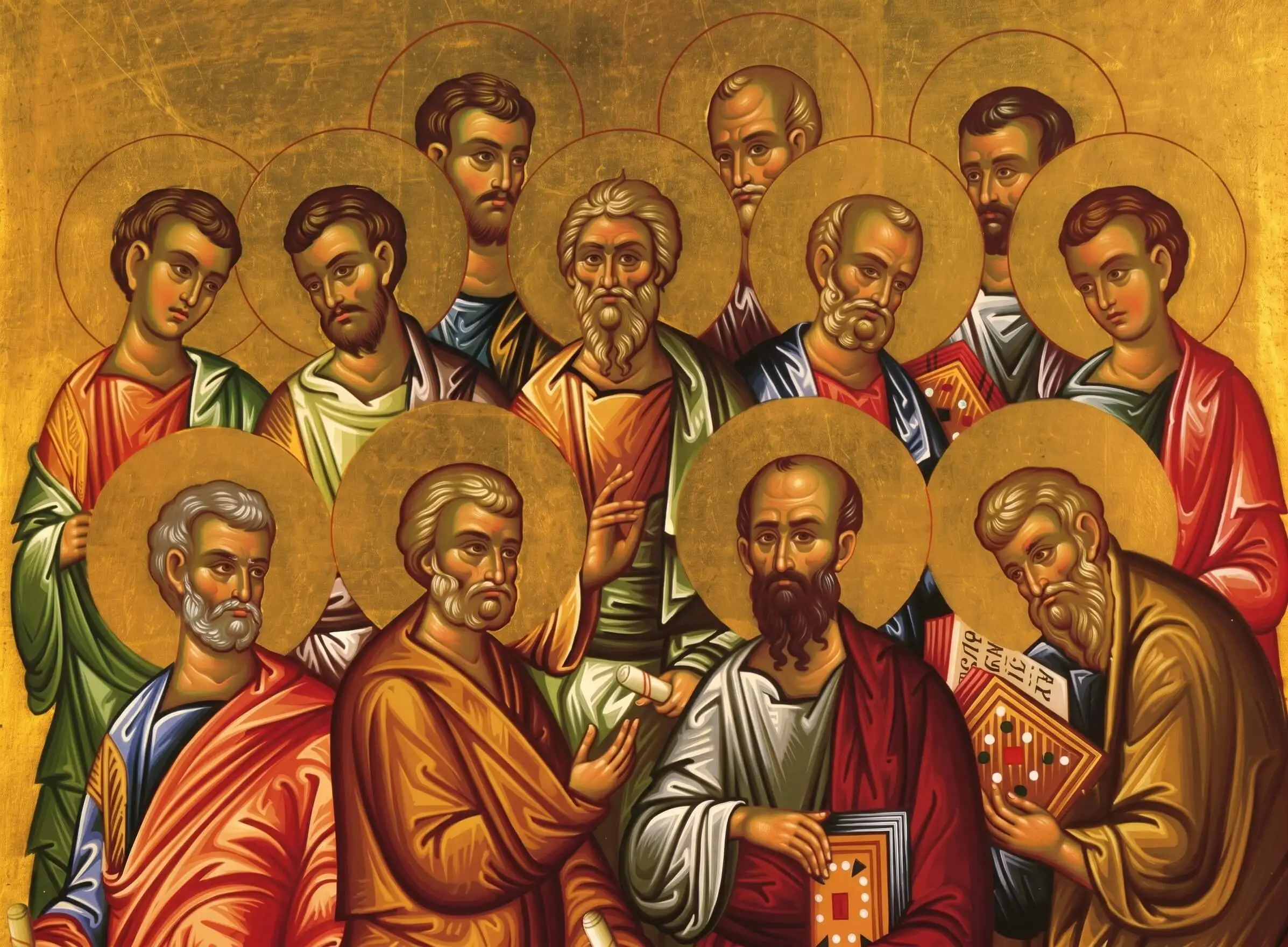
The Holy Martyr Justin the Philosopher was born around 114 at Sychem, an ancient city of Samaria. Justin’s parents were pagan Greeks. From his childhood the saint displayed intelligence, love for knowledge and a fervent devotion to the knowledge of Truth. When he came of age he studied the various schools of Greek philosophy: the Stoics, the Peripatetics, the Pythagoreans, the Platonists, and he concluded that none of these pagan teachings revealed the way to knowledge of the true God.
Once, when he was strolling in a solitary place beyond the city and pondering about where to seek the way to the knowledge of Truth, he met an old man. In the ensuing conversation he revealed to Justin the essential nature of the Christian teaching and advised him to seek the answers to all the questions of life in the books of Holy Scripture. “But before anything else,” said the holy Elder, “pray diligently to God, so that He might open to you the doors of Light. No one is able to comprehend Truth, unless he is granted understanding from God Himself, Who reveals it to each one who seeks Him in prayer and in love.”
In his thirtieth year, Justin accepted holy Baptism (between the years 133 and 137). From this time Saint Justin devoted his talents and vast philosophical knowledge to preaching the Gospel among the pagans. He began to journey throughout the Roman Empire, sowing the seeds of faith. “Whosoever is able to proclaim Truth and does not proclaim it will be condemned by God,” he wrote.
Justin opened a school of Christian philosophy. Saint Justin subsequently defended the truth of Christian teaching, persuasively confuting pagan sophistry (in a debate with the Cynic philosopher Crescentius) and heretical distortions of Christianity. He also spoke out against the teachings of the Gnostic Marcian.
In the year 155, when the emperor Antoninus Pius (138-161) started a persecution against Christians, Saint Justin personally gave him an Apology in defense of two Christians innocently condemned to execution, Ptolemy and Lucias. The name of the third remains unknown.
In the Apology he demonstrated the falseness of the slander against Christians accused unjustly for merely having the name of Christians. The Apology had such a favorable effect upon the emperor that he ceased the persecution. Saint Justin journeyed, by decision of the emperor, to Asia Minor where they were persecuting Christians with particular severity. He proclaimed the joyous message of the imperial edict throughout the surrounding cities and countryside.
The debate of Saint Justin with the Rabbi Trypho took place at Ephesus. The Orthodox philosopher demonstrated the truth of the Christian teaching of faith on the basis of the Old Testament prophetic writings. Saint Justin gave an account of this debate in his work Dialogue with Trypho the Jew.
A second Apology of Saint Justin was addressed to the Roman Senate. It was written in the year 161, soon after Marcus Aurelius (161-180) ascended the throne.
When he returned to Italy, Saint Justin, like the Apostles, preached the Gospel everywhere, converting many to the Christian Faith. When the saint arrived at Rome, the envious Crescentius, whom Justin always defeated in debate, brought many false accusations against him before the Roman court. Saint Justin was put under guard, subjected to torture and suffered martyrdom in 165. The relics of Saint Justin the Philosopher rest in Rome.
Martyr Justin the Philosopher
The Holy Martyr Justin the Philosopher was born around 114 at Sychem, an ancient city of Samaria. Justin’s parents were pagan Greeks. From his childhood the saint displayed intelligence, love for knowledge and a fervent devotion to the knowledge of Truth. When he came of age he studied the various schools of Greek philosophy: the Stoics, the Peripatetics, the Pythagoreans, the Platonists, and he concluded that none of these pagan teachings revealed the way to knowledge of the true God.
Once, when he was strolling in a solitary place beyond the city and pondering about where to seek the way to the knowledge of Truth, he met an old man. In the ensuing conversation he revealed to Justin the essential nature of the Christian teaching and advised him to seek the answers to all the questions of life in the books of Holy Scripture. “But before anything else,” said the holy Elder, “pray diligently to God, so that He might open to you the doors of Light. No one is able to comprehend Truth, unless he is granted understanding from God Himself, Who reveals it to each one who seeks Him in prayer and in love.”
In his thirtieth year, Justin accepted holy Baptism (between the years 133 and 137). From this time Saint Justin devoted his talents and vast philosophical knowledge to preaching the Gospel among the pagans. He began to journey throughout the Roman Empire, sowing the seeds of faith. “Whosoever is able to proclaim Truth and does not proclaim it will be condemned by God,” he wrote.
Justin opened a school of Christian philosophy. Saint Justin subsequently defended the truth of Christian teaching, persuasively confuting pagan sophistry (in a debate with the Cynic philosopher Crescentius) and heretical distortions of Christianity. He also spoke out against the teachings of the Gnostic Marcian.
In the year 155, when the emperor Antoninus Pius (138-161) started a persecution against Christians, Saint Justin personally gave him an Apology in defense of two Christians innocently condemned to execution, Ptolemy and Lucias. The name of the third remains unknown.
In the Apology he demonstrated the falseness of the slander against Christians accused unjustly for merely having the name of Christians. The Apology had such a favorable effect upon the emperor that he ceased the persecution. Saint Justin journeyed, by decision of the emperor, to Asia Minor where they were persecuting Christians with particular severity. He proclaimed the joyous message of the imperial edict throughout the surrounding cities and countryside.
The debate of Saint Justin with the Rabbi Trypho took place at Ephesus. The Orthodox philosopher demonstrated the truth of the Christian teaching of faith on the basis of the Old Testament prophetic writings. Saint Justin gave an account of this debate in his work Dialogue with Trypho the Jew.
A second Apology of Saint Justin was addressed to the Roman Senate. It was written in the year 161, soon after Marcus Aurelius (161-180) ascended the throne.
When he returned to Italy, Saint Justin, like the Apostles, preached the Gospel everywhere, converting many to the Christian Faith. When the saint arrived at Rome, the envious Crescentius, whom Justin always defeated in debate, brought many false accusations against him before the Roman court. Saint Justin was put under guard, subjected to torture and suffered martyrdom in 165. The relics of Saint Justin the Philosopher rest in Rome.
In addition to the above-mentioned works, the following are also attributed to the holy martyr Justin the Philosopher:
1) An Address to the Greeks
2) A Hortatory Address to the Greeks
3) On the Sole Government of God
Saint John of Damascus preserved a significant part of Saint Justin’s On the Resurrection, which has not survived. The church historian Eusebius asserts that Saint Justin wrote books entitled
The Singer
Denunciation of all Existing Heresies and
Against Marcian
In the Russian Church the memory of the martyr is particularly glorified in temples of his name. He is invoked by those who seek help in their studies.
The holy martyrs Justin, Chariton, Euelpistus, Hierax, Peonus, Valerian, Justus and the martyr Charito suffered with Saint Justin the Philosopher in the year 166. They were brought to Rome and thrown into prison. The saints bravely confessed their faith in Christ before the court of the prefect Rusticus. Rusticus asked Saint Justin, whether he really thought that after undergoing tortures he would go to heaven and receive a reward from God. Saint Justin answered, “Not only do I think this, but I know and am fully assured of it.”
The prefect proposed to all the Christian prisoners that they offer sacrifice to the pagan gods. When they refused he issued a sentence of death, and the saints were beheaded.

Spiritual Maturity
“For though by this time you ought to be teachers, you need someone to teach you again the first principles of the oracles of God; and you have come to need milk and not solid food. For everyone who partakes only of milk is unskilled in the word of righteousness, for he is a babe. But solid food belongs to those who are of full age, that is, those who by reason of use have their senses exercised to discern both good and evil.” (Hebrews 5:12-15)
We as God’s children have a responsibility to press on to maturity. We are on a continual spiritual growth track. To grow spiritually means to grow in grace and knowledge of our Lord and Savior Jesus Christ. The Gospel tells us how a Christian can grow spiritually. It is Christ's power in the believer that gives us the ability to grow spiritually. As we rely on His power and obey His commands, we can develop maturity. Since God is the source of all spiritual development, we cannot neglect Him and expect to become mature. Transformation begins with time in His Word and prayer. No one accidentally becomes mature. Spiritual growth requires a diligent pursuit of God. When we are mature in Christ, we recognize our own inadequacy and rely on the Holy Spirit within us. It's His job to transform our character and empower us to accomplish everything the Lord calls us to do.
To evaluate our spiritual growth, we can measure our improvement in the "fruit of the Spirit." The Holy Spirit in us produces qualities in us, love, joy, peace, patience, kindness, goodness, faithfulness, gentleness, self-control. If we are increasing in love, in joy, in patience, we are growing spiritually. It is God's will that we grow to be more like Jesus. We also have the promise that the Lord Himself will oversee our growth and bring us to maturity. He who began a good work in us will carry it on to completion until the day of Christ Jesus.
Listen to Paul’s words, that the observance of the Law overthrows the Gospel, and learn, if you continue to do this, how this comes to pass, and tremble, and shun this pitfall. How you still keep the sabbath, and fast with the Jews? Is it that you still fear the Law and abandonment of its letter? By doing this, you see faith as weak, and by itself powerless to save. A fear to omit the sabbath plainly shows that you fear the Law as still in force; and if the Law is needful, it is so as a whole, not in part, nor in one commandment only; and if as a whole, the righteousness which is by faith is little by little shut out. If you keep the sabbath, why not also be circumcised? and if circumcised, why not also offer sacrifices? If the Law is to be observed, it must be observed as a whole, or not at all.” (Homilies on Galatians 2:17 [A.D. 395]).
First, the New Testament says in the Epistle of James (James2:19) that you believe that there is one God, You do well, Even the demons believe—and tremble!. So the mere fact of believing in itself, Satan surpasses us in this matter cause he is the first to experience his defeat by the authority of Christ through salvation. Secondly, St. John, in his Gospel, defined faith as accepting and receiving Christ and defined the believer as he is the one who received Christ and be united with Him in the Holy Spirit (John1:12) .
Thirdly, St. John puts imperative signs and specifications for the believer, saying that everyone who loves has been born of God, and whoever does not love has not known God (1John 4:7). So the crucial question now is, then, does faith in Christ alone saves? The answer is definitely yes, If this faith leads to the acceptance of Christ, uniting with Him and submitting to Him, and this faith must yield a life of love and obedience to God’s commandment (John14:21).
History has failed at different stages and in many places worldwide to present the Gospel of Christ for what it is. In contrast, religious people and some clergymen have shown faint images of a God who does nothing for human beings. They deny the reality of the crude contradiction between an Old Testament full of the history of the ancient people and their laws ordering the killing of males by the sword and the plundering of women and children (Deuteronomy20:13-14,) and the Gospel of Christ and His New Covenant calling us to love our enemies and pray for those who persecute us (Mathew 5:44-45.) Their churches and meetings became devoid of Christ’s works of love to heal the sick and to free those bound from Satan. Unfortunately, these ministries turned into a form of business and wealth. And it is these images, which do not reflect the truth of the Gospel or Christ’s applied works in human lives, that the young people see as Christianity as presented by them.
Therefore, it was necessary to alert everyone’s mind to the importance of reading the Gospel of the New Testament yourself to find out the truth of Christianity and the principles of the teaching of Christ, free from the Jewish intellectual influences carried by many missionaries and preachers. They underestimated and clouded the importance of God’s appearance in the flesh in Jesus Christ to reveal to the whole world the truth and the essence of God the Father by holding on to the preaching of the stories of the ancient people and their history who were waiting for the Savior’s coming as their prophets prophesied. Jesus Christ, the only begotten Son of God, came to reveal to all humanity the love of the Heavenly Father, His salvation plan, and His direct intervention in the lives of His people yesterday, today, and tomorrow. He came to give us the power over sin and death, which entered the world through Satan’s temptation, “Therefore, just as through one man sin entered the world, and death through sin, and thus death spread to all men, because all sinned” ( Romans 5:12.) God the Father is not a killer, He is the source of life to man “ For God so loved the world that He gave His only begotten Son, that whoever believes in Him should not perish but have everlasting life. For God did not send His Son into the world to condemn the world, but that the world through Him might be saved.” (John 3:17.) The killer is Satan who came to steel, slaughter, and to destroy, “The thief does not come except to steal, and to kill, and to destroy. I have come that they may have life, and that they may have it more abundantly”(John 10:10.) If we begin a real and profound relationship with Christ; in that case we will choose the life-changing power of Christ’s presence that is active in us, that changes us from a formal Christianity that has done nothing for man to the life of Christ filled with the triumph over evil, joy, and peace with God and the others.
Now we know that God gave us commandments to follow not as rules to be obeyed, and if not obeyed, we will be punished, but as guidance to be away from the devil, the enemy, and the killer of man. He created us with a free will to choose either His guidance and so to unite with His eternal life and His goodness or choose Satan’s worldly, tempting, and sinful ways and so to unite with his evil spirit, his death, and his eternal fire. This is the New Testament and Christianity.
God my Father,
I come before you now with a request for a softer heart. Too often have I allowed circumstances to make me cynical, callous, and selfish. Then, finally, I reach a certain threshold and don't think I can take it anymore. I'm afraid of continuing to be hurt. I'm afraid of being misused, abused, and abandoned. I'm afraid of the past repeating itself.
Lord, I ask that you take away this fear. Please soften my heart so I would better serve you and those you've placed in my life. Help me to live a life dedicated to you, one without fear of suffering and one where the trials make me better, not bitter. Please soften my heart, Lord.
In Jesus' name, I pray. Amen.
“Though I speak with the tongues of men and of angels, but have not love, I have become sounding brass or a clanging cymbal. And though I have the gift of prophecy, and understand all mysteries and all knowledge, and though I have all faith, so that I could remove mountains, but have not love, I am nothing. And though I bestow all my goods to feed the poor, and though I give my body to be burned, but have not love, it profits me nothing. Love suffers long and is kind; love does not envy; love does not parade itself, is not puffed up; does not behave rudely, does not seek its own, is not provoked, thinks no evil; does not rejoice in iniquity, but rejoices in the truth; bears all things, believes all things, hopes all things, endures all things. Love never fails. But whether there are prophecies, they will fail; whether there are tongues, they will cease; whether there is knowledge, it will vanish away. For we know in part and we prophesy in part. But when that which is perfect has come, then that which is in part will be done away. … And now abide faith, hope, love, these three; but the greatest of these is love.”
1- Love suffers long.
2- Love is kind.
3- love does not envy.
4- love does not parade itself.
5- Love is not puffed up.
6- Love does not behave rudely.
7- Love does not seek its own.
8- Love is not provoked.
9- Love thinks no evil.
10- Love does not rejoice in iniquity.
11- Love rejoices in the truth.
12- Love bears all things.
13- Love believes all things.
14- Love hopes all things.
15- Love endures all things.
1- The gift of prophecy,
2- Understand all mysteries and all knowledge,
3- I have all faith, so that I could remove mountains,
4- I bestow all my goods to feed the poor,
5- I give my body to be burned
I AM NOTHING WITHOUT LOVE
BECAUSE LOVE NEVER FAILS
BUT
1- Whether there are prophecies, they will fail.
2- Whether there are tongues, they will cease.
3- Whether there is knowledge, it will vanish away.
4- For we know in part and we prophesy in part.
BUT